What are Autonomous Coding Agents?+
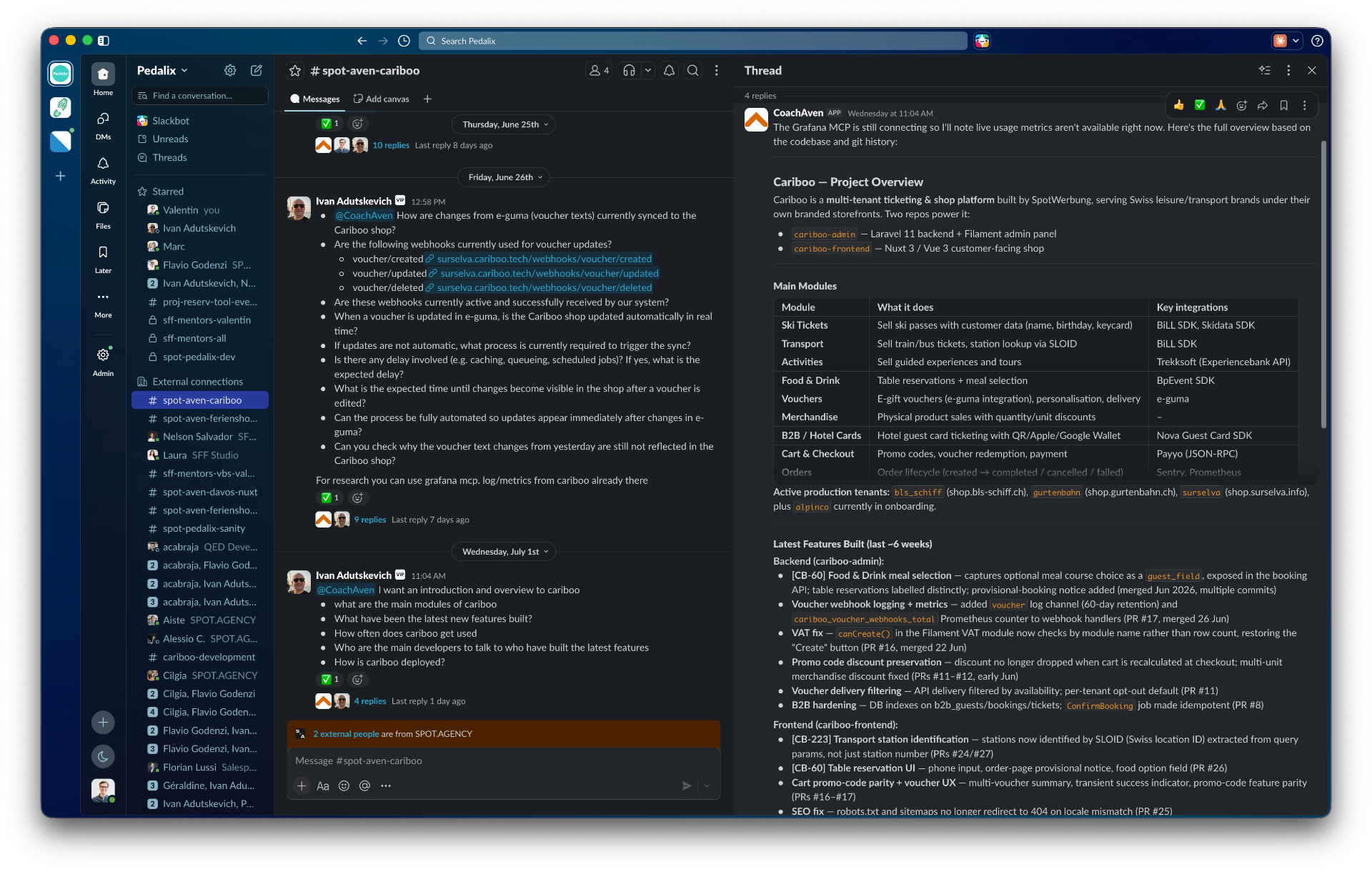
Autonomous Coding Agents are AI agents that work in your product team's repo: they read the code, answer questions, estimate work and open pull requests. Your developers review and merge. Pedalix builds these agents into your company, with Coach Aven, the coding agent in your Slack, built by Pedalix, and makes your team AI-native.
Does this replace our developers?+
No. Your developers set the direction, review and merge. The agent prepares and handles repeatable work. Responsibility for the code stays with your team.
Why does the agent live in Slack and not just in the IDE?+
Because adoption happens by watching. In Slack the whole team sees how engineers hand the agent tasks and what comes back. The way of working spreads by pull, not by push, beyond engineering too. An agent that only lives in the IDE stays invisible.
Are we allowed to do this with our data?+
Yes, because sovereignty is built in, not bolted on: Swiss and EU hosting, your data stays in-house. Coach Aven, the coding agent, runs on your server and on your knowledge. You can hand the audit trail to procurement.
Do we stay in control?+
Yes. Every answer cites its source, every agent has clear boundaries, every run is logged. Your team merges the pull requests, not the agent.
Will AI become a reflex, or fall asleep after three months?+
That's exactly where most attempts fail. So we work from assessment through strategy and culture change to daily practice: coding agents become part of the team DNA, not a workshop souvenir.
What is Teklens?+
Teklens is the Company Brain for tech companies, ready for every AI agent. It connects company knowledge, meeting notes and decisions from your existing tools and shows where ongoing work drifts from them. You review the proposed changes and approve them. Teklens is an independent product and not part of Coach Aven. More at teklens.ai.
What do you do for boards and investors?+
Product, team and technology assessments: a fast, well-founded verdict on technology, team and product. Pre-invest, post-invest or pre-exit: where the hidden tech debt sits, how scalable the asset is, how AI-ready it is.