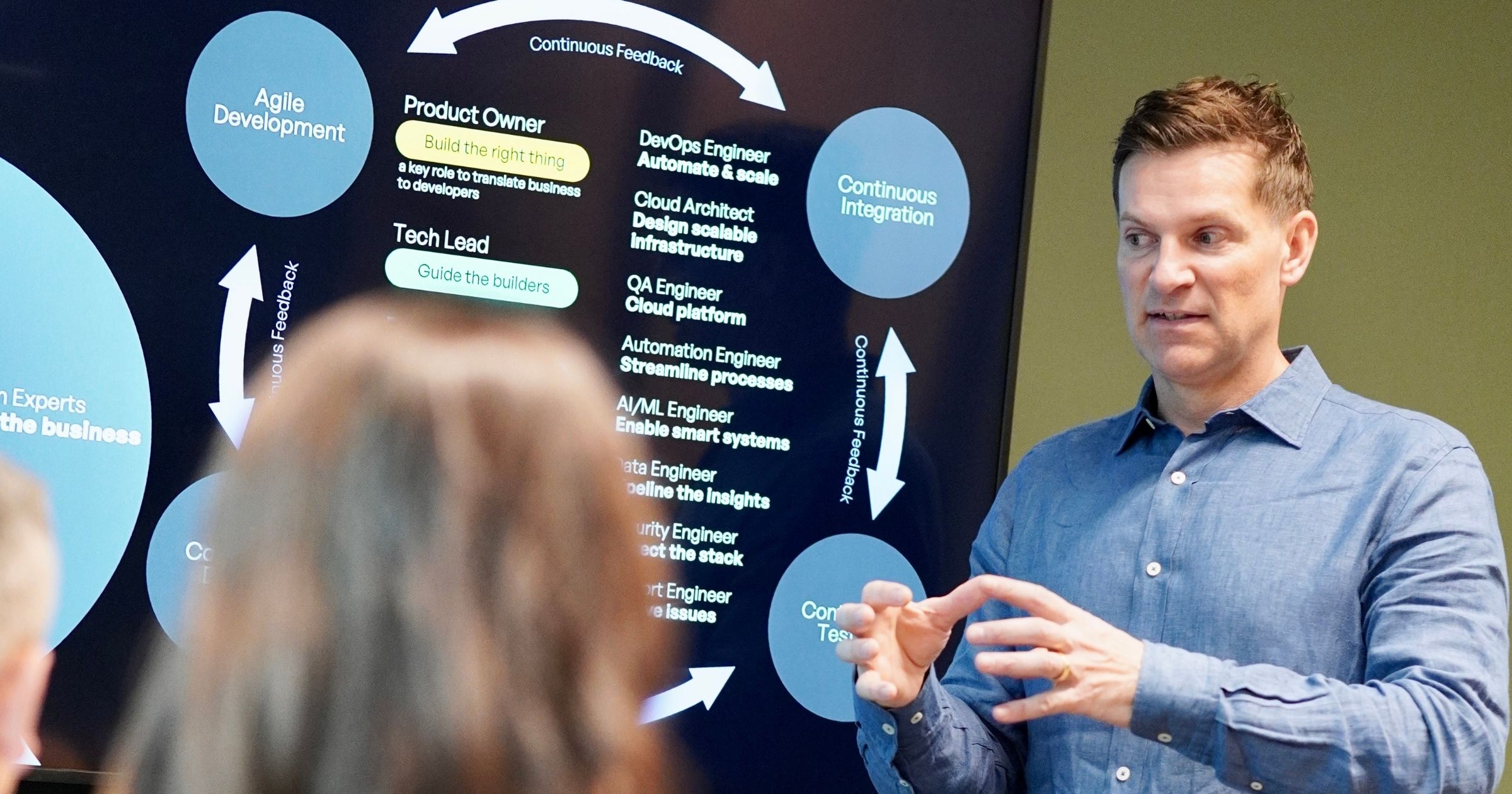
TL;DR. AI Product Management does not mean automatically generating PRDs. It transforms the Product Manager from an author into a curator of signals. Instead of wasting time on documentation, modern PMs use AI to analyse sales calls and support tickets. This leads to data-based discovery and halves the failure rate of features. The focus shifts from accelerated delivery to precise prioritisation for real growth.
The hamster wheel of context and noise
Software founders and product leaders know the problem. The Product Manager is drowning in data. They juggle support tickets, notes from sales calls, telemetry data, and stakeholder requests. The result is often prioritisation based on gut feeling or political pressure. Whoever shouts the loudest gets the feature.
In B2B SaaS companies, this context overload leads to slow cycles. A PM spends hours sifting through feedback instead of identifying patterns. Attempting to structure everything manually fails once a company reaches a certain size of 20 to 50 employees. The information is there, but it is scattered and unused. This inefficiency costs revenue because the team builds the wrong things.
The point: Discovery-First through curation
The conventional approach uses AI for delivery, such as writing user stories. This is a mistake. It only accelerates the production of potential waste. The true leverage lies in discovery.
The thesis: AI Product Management is Discovery-First, not Delivery-First.
- PMs analyse ten times more customer input in the same time.
- Structured signals replace subjective assessments.
- Decisions are based on evidence rather than eloquence.
- The role changes from the writing PM to the curating strategist.
Why automated PRDs make the problem worse
Many teams now have PRDs generated for them. The result sounds plausible but is often hollow. Without context, an AI does not know the strategic differentiation from the competition. It does not know which alternative the customer currently uses and why it fails.
If a PM automates this step, they fill the roadmap with well-written noise. The goal of AI Product Management is the structuring of signals, not the outsourcing of thinking. A good document only emerges when the AI performs the preliminary work of signal aggregation and the human makes the strategic decision.
A modern workflow for AI-native teams
Effective product teams establish a new rhythm for their pipeline. This consists of five clear steps:
- Signal Aggregation: All inputs from Intercom, Gong, or Salesforce end up in a central store.
- Discovery Run: An LLM clusters these signals weekly by topic, segment, and deal size.
- Curation Meeting: The PM presents the facts from the clusters. The team decides on the next step.
- Edited Draft: The AI writes a draft based on real customer quotes. The PM sharpens the strategy.
- Feedback Loop: After the release, usage data flows back into the store to close the circle.
Tools like teklens.ai or specialised CRM integrations make this process possible. It is about shortening the distance between the customer voice and the code.
The measurable effect: Less feature waste
The strongest metric in product management is the feature failure rate. This refers to the proportion of functions that are used by less than five per cent of the target group six months after release. This is the most expensive item on a SaaS company's balance sheet.
AI-native discovery reduces this rate drastically. In practice, we observe a halving of the share of unused features. The PM no longer enters the prioritisation call with an opinion, but with verifiable clusters. This reduces internal politics and increases the focus on Product-Market Fit. The pipeline becomes cleaner because bad ideas are sorted out earlier.
Switching from author to curator
What works is using AI as an analytical tool for unstructured data. What fails is the blind automation of documentation without human supervision. Anyone processing customer data must also pay attention to compliance and PII protection. A pure GPT prompt without a data protection layer is not an option with 500 employees.
The deeper insight: AI does not change what you decide, but the basis on which you do it. Those who ignore the shift towards becoming a curator will continue to build perfectly documented but useless features. Learn more about this change in our guide to AI Product Management.